
Dual Plane Balancing Calculator
Dual Plane Balancing Calculator is currently under construction. Once ready, it will be published across our social media pages Stay tuned for updates and be the first to explore this powerful tool when it goes live!
Mass Splitting & Mass Consolidation
Balancing challenges often require splitting or consolidating correction masses — but manual calculations can be time‑consuming and error‑prone. To make this process simpler, we’ve developed a Mass Splitting and Mass Consolidation Calculator. Quickly determine how to split a correction mass into multiple planes. Consolidate distributed masses into a single equivalent correction. Save time and reduce […]
Single Plane Balancing Calculator
Unbalance is one of the most common causes of vibration in rotating machinery. Left unchecked, it can lead to excessive wear, energy loss, and costly downtime. Single plane balancing is an effective method for rotors with a length‑to‑diameter ratio less than 0.5. By combining vibration measurements with phase readings, the correction weight and angle needed […]
Time Waveform Input Selection Calculator
Fault diagnosis in vibration analysis relies heavily on both the FFT spectrum and time waveform analysis. These signals are influenced by two key input parameters: Maximum Frequency (Fmax) and Lines of Resolution (LOR). Although the FFT spectrum is derived from the raw time signal, the optimal parameters chosen for FFT analysis may not always be […]
Allowable Unbalance Calculator
According to ISO 1940, the success of dynamic balancing can be verified either by assessing the vibration levels against ISO standards or by calculating the allowable residual unbalance values. The calculation of allowable unbalance is particularly useful when balancing is performed at lower speeds, as it provides a reliable benchmark for determining whether the rotor […]
Trial Mass Calculator
As per Victor Wowk / Crawford, the trial mass added to the rotor must create a force equivalent to 10% of the rotor weight, which means It should be large enough to produce a measurable vibration change of 30% and/or phase change of 30 degree. small enough to avoid overstressing the rotor or introducing excessive […]
Phase relationship between D-V-A
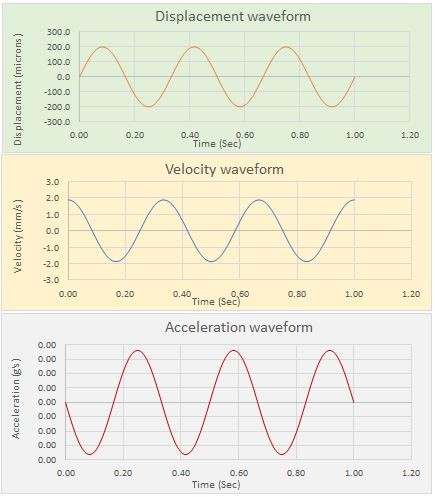
The purpose of this post is to offer some fundamental clarity on the Phase relationship between Displacement-Velocity-Acceleration. There are many ways to explain this relationship like using pendulum, or from the waveform by indicating the time difference between the peaks. In this post, only the mathematical explanation is provided. Let’s consider a sinusoidal (single discrete […]
Relationship between Heavy spot, High spot and Vibration vectors
There are lot of confusions roaming around “High spot” and its relationship with vibration vectors (D-V-A). The purpose of this article is to shed some light on this topic. The image shown below will be referred throughout this text. Many don’t have any second opinion about Heavy spot – It is the angular location of […]